

In this guide (10 sections)
- Before the Dinner: The Planning Conversation
- The Day Before: Shopping and Preparation
- Arrival: The Chef Sets Up
- As Guests Arrive: Appetisers and the First Impression
- The Seated Dinner: Course by Course
- During the Meal: The Chef's Presence
- After the Last Course: Cleanup
- After Your Guests Leave
- What a Private Chef Dinner Costs
- Ready to Try It?
Most people who hire a private chef for the first time say the same thing afterwards: they wish they'd done it sooner. Not because the food surprised them — though it usually does — but because the whole experience was so different from what they imagined.
If you've never had a private chef dinner at your home, you probably have a mental picture of what it looks like. A chef in whites, a formal table, an intimidating atmosphere. Or maybe the opposite — someone quietly cooking in the background while you pretend they're not there.
The reality is warmer, more relaxed, and more personal than either of those images. Here's exactly what happens during a private chef dinner party experience, from the moment you start planning to the moment the last dish is cleared.
Plan your event - Enquiry | Request a Chef | Platesfull
If you are looking to hire a private chef
- Austin -Austin Private Chef | Dinner Parties from $95/Guest
- San Diego - San Diego Private Chef | Dinner Parties from $115/Guest
- Fredericksburg - Fredericksburg Private Chef | Hill Country Dinners $90/Guest
- Los Angeles - Private Chef in Los Angeles | Dinner Parties from $115/Guest
- Miami - Miami Private Chef | Dinner Parties & Yacht Menus $125+
- New York -Private Chef NYC | Manhattan & Brooklyn from $120/Guest
- Nashville – Private Chef Nashville | Book an In-Home Chef
- Denver - Private Chef Denver | Book an In-Home Chef
- Private Chef in San Antonio, TX | Platesfull
Before the Dinner: The Planning Conversation
A private chef experience doesn't start when the chef walks through your door. It starts days or weeks before, with a conversation that makes the whole evening possible.
After you book through Platesfull, your chef will reach out to discuss the details. This isn't a brief administrative exchange — it's the foundation of the entire dinner. A good chef will want to know:
Who are your guests? The number of people matters for portion planning, but more importantly, the chef wants to understand who's coming. Close friends, family, colleagues, a first-time group of new acquaintances? The social dynamic shapes how formal or relaxed the service should feel.
Are there any dietary restrictions or allergies? This is taken seriously, not as an inconvenience. A private chef who knows about a shellfish allergy will design the entire menu so that person never feels like they're eating a modified version of the real dinner. A great chef makes dietary restrictions invisible.
What does the guest of honour love to eat? If it's a birthday dinner, an anniversary, or any occasion tied to a specific person, the chef will ask about that person's favourite flavours, cuisines, or dishes. This is where the personalisation begins — and it's what makes a private chef dinner feel fundamentally different from a restaurant.
What's your kitchen like? Your chef needs to know what equipment they're working with — oven size, gas or electric hob, outdoor grill, counter space. Most private chefs can work with almost any home kitchen, but knowing in advance means nothing surprises them on the night.
What's the tone you're going for? A relaxed dinner where courses arrive casually and conversation flows freely is a different experience from a more structured tasting menu format. You tell the chef which direction you want and they calibrate everything around it.
By the end of this conversation, your chef has a complete picture of the evening. They'll propose a menu, discuss any tweaks you want to make, and confirm the final details. Some chefs share the menu with you in advance so you can show guests what's coming. Others keep it as a surprise — whatever you prefer.
Tell us your date, city and guest count. Vetted chefs send menus with all-inclusive per-person prices. Free, no obligation.

The Day Before: Shopping and Preparation
What you won't see — because it happens without you — is the work your chef puts in before they ever arrive at your door.
On the day before your dinner, or the morning of, your chef goes to market. Not to a supermarket for convenience ingredients, but to wherever the best produce is. Farmers markets, specialty fishmongers, a trusted butcher, an artisan cheese shop. Private chefs shop the way good home cooks wish they had time to — selecting ingredients at peak quality rather than grabbing whatever is in stock.
Some preparation also happens in advance. Sauces that benefit from time, stocks that need hours on the stove, pastry dough that needs to rest, pickled vegetables or cured elements that need to be made ahead. The dishes your guests will eat in a few hours have often been in progress for a day or more before they arrive.
This is one of the fundamental differences between a private chef dinner and cooking at home. The quality of the ingredients and the depth of preparation are simply at a different level — not because you lack ability, but because a private chef has the time, sourcing relationships, and professional knowledge to do things that are impractical in everyday home cooking.
Arrival: The Chef Sets Up
Your chef arrives at your home typically one and a half to two hours before dinner is scheduled to begin. The exact timing depends on the complexity of the menu and the number of courses, but for most dinner parties this window gives the chef enough time to set up and begin cooking without any sense of rush.
Here's what that arrival looks like in practice.
The chef comes with everything. Ingredients, speciality equipment, knives, pans, any serving ware they need. Your kitchen doesn't need to be stocked beyond its normal state. In most cases, the chef will also bring their own apron, towels, and any finishing garnishes or specialty items your home kitchen wouldn't have.
They'll introduce themselves briefly, get a quick tour of the kitchen, and then get to work. Most chefs are professional and focused during setup — there's a flow to their preparation that you'll notice immediately. Every movement is purposeful. They're building toward a sequence of courses that need to arrive at exactly the right moment.
As a host, you don't need to do anything during this time. That's the point. You get ready, greet your guests, and let the chef take care of the rest.
As Guests Arrive: Appetisers and the First Impression
While your guests are arriving and the first drinks are being poured, your chef typically sends out the opening act.
This might be passed appetisers — small bites that circulate through the room on a board or slate, something for guests to pick up while they're finding their feet and catching up. It might be a grazing board set out on the kitchen island or dining table — cured meats, artisan cheeses, olives, fresh bread, seasonal fruit. It might be amuse-bouche sized single bites, each one a miniature declaration of what the evening is going to taste like.
The purpose of this first course is more than just feeding guests who are hungry. It sets the tone. It tells the room that this evening is going to be different. Guests see the care in presentation, taste something they weren't expecting, and the energy of the evening shifts. People relax. Conversation opens up. The arrival nerves that always accompany a dinner party begin to dissolve.
The chef is in the kitchen during this time, cooking quietly and precisely. The sound of something sizzling, the smell of something roasting — the kitchen becomes a background element of the evening rather than a source of stress.
The Seated Dinner: Course by Course
When the moment is right — not by a rigid clock, but when the energy of the room feels ready — the chef signals that dinner is served and guests take their seats.
What follows is one of the most pleasurable things a dinner party can offer: a meal that arrives in its own time, each course building on the last, without anyone at the table having to get up, check the oven, or apologise for being five minutes behind.
The first course is typically light and elegant — something that opens the palate rather than filling it. A beautifully constructed salad with ingredients you'd never combine at home. A cold soup with a garnish that took more care than the entire dish appears to require. A crudo or a carpaccio, knife-thin and seasoned with quiet precision.
The middle courses build in richness and complexity. Depending on your menu, this might be a pasta course, a fish course, or a palate-cleansing sorbet between heavier dishes. Each plate arrives looking genuinely beautiful — not in a precious, intimidating way, but in the way that tells you someone cared about what you're about to eat.
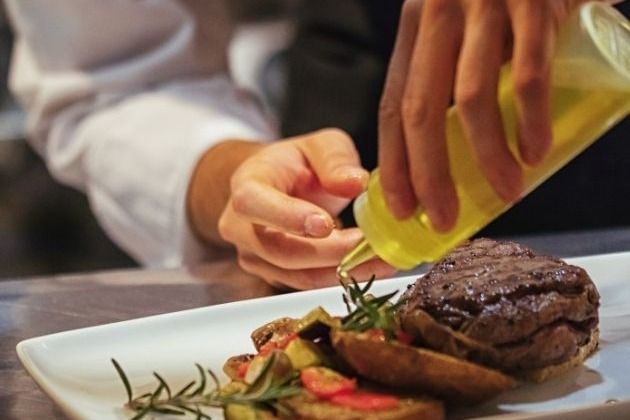
The main course is the anchor of the evening. Whatever the chef prepared — a slow-roasted lamb rack, a whole roasted fish, a perfectly executed beef tenderloin, a stunning vegetarian centrepiece — it arrives at the table at the exact right temperature, plated properly, and served with whatever accompaniments make it complete.
Between courses, the chef clears and resets. This happens quietly, professionally, and without interruption to the conversation. Most guests barely notice it. What they notice is that the table always looks right and the next course always arrives at exactly the moment they're ready for it.
The dessert closes the meal. A private chef dessert is rarely an afterthought — it's often the course that generates the most response from guests, because it's where a chef's creative expression tends to be most visible. A deconstructed tart, a warm chocolate fondant, a seasonal fruit dessert with a housemade ice cream, a cheese course with accompaniments that make the pairing obvious and delicious.
During the Meal: The Chef's Presence
One of the most common questions first-time clients ask is whether the chef stays in the kitchen the whole time or interacts with guests.
The answer depends on the format you've chosen and the chef's style, but in most private chef dinners the chef occupies a comfortable middle ground. They're present enough to explain a dish if guests are curious — and they often are — but not intrusive enough to interrupt the flow of conversation.
Many guests find this element of the evening genuinely enjoyable. When a chef comes out briefly to explain what went into a particular course — where the fish was sourced, why a specific spice combination was chosen, what technique produced a particular texture — it adds a layer of engagement to the meal that a restaurant can't replicate. You're not reading a menu description. You're hearing it from the person who made the decision.
Some hosts prefer to keep this element minimal and let the food speak entirely for itself. Others want the chef to be more of a presence, explaining each course in detail. Both are completely fine — you set the tone in your planning conversation.
After the Last Course: Cleanup
This is the part of a private chef dinner that hosts consistently say surprised them most.
The chef cleans up.
Not a perfunctory rinse of a few pans, but a full, thorough cleanup. The kitchen is returned to the condition it was in when they arrived, or better. Dishes are washed, surfaces are wiped down, the bin is sorted, equipment is packed. By the time your guests are finishing their last glass of wine, the kitchen looks like no one cooked in it at all.
For anyone who has hosted a dinner party the traditional way, this is the most visceral demonstration of what a private chef experience actually delivers. You don't end the evening doing dishes. You end the evening still at the table, still in conversation, with no task waiting for you in the kitchen when the last guest leaves.
After Your Guests Leave
When everyone has gone home, you'll notice a few things.
The kitchen is clean. The dining room looks like you could have guests again tomorrow. And you — as the host — actually feel like you were at the party. Not like you organised it and managed it from the kitchen all evening, but like you attended it, enjoyed it, and were present for all of it.
That is the private chef experience. Not just exceptional food, though it is that. It's the restoration of the host to their own party. It's the ability to be fully present with your guests on an evening that was worth being present for.
What a Private Chef Dinner Costs
For a group of 6 to 10 guests at a home dinner party, most private chef experiences through Platesfull fall between $500 and $1,200 depending on the menu complexity, location, and length of service. This typically includes groceries, preparation, cooking, service, and full cleanup.
On a per-person basis, a multi-course private chef dinner for 8 people often works out to $75 to $150 per head — comparable to a quality restaurant, but the experience is entirely private, entirely personalised, and entirely yours.
For milestone occasions — a significant birthday, an anniversary, a proposal dinner — that comparison becomes even easier. A restaurant charges similar prices and gives you a table among strangers. A private chef gives you the entire evening.
→ Browse Private Chefs & Menus | Platesfull
Ready to Try It?
If you've been curious about hiring a private chef for a dinner party, the planning conversation is the best place to start. Browsing chefs on Platesfull, seeing their menus and reviews, and sending a simple inquiry takes about five minutes.
Most first-time clients say they went in slightly nervous and came out wondering why they waited so long. The food is memorable. The service is professional. The cleanup is real. And the experience of hosting a dinner party without the labour of hosting a dinner party is — as it turns out — exactly as good as it sounds.
Now that you know what to expect, here's exactly how to make it happen. Our step-by-step hiring guide walks first-time hosts through the full process — from initial search to day-of prep. Read: How to Hire a Private Chef: A Step-by-Step Guide for First-Time Hosts (2026)
Browse Private Chefs & Menus | Platesfull
Platesfull connects hosts across the US with experienced private chefs for dinner parties, celebrations, and special occasions. Browse chefs, view menus, and get a free quote at platesfull.com.


